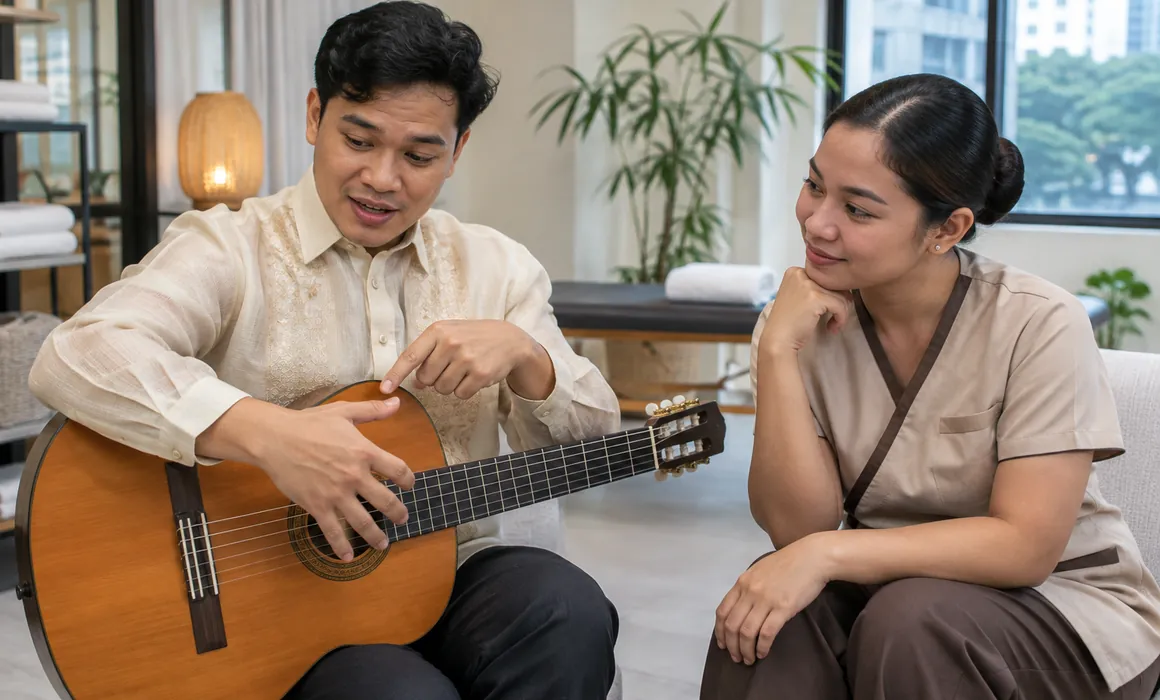
A guitarist’s fretting hand, a violinist’s bow arm, and a pianist’s hands at the keys work differently. When you request massage for musicians, describe your actual playing day. Which hand held a position? Which hand repeated a movement? At what point in rehearsal did ordinary effort begin to feel different? Your answer can shape a comfortable appointment and help you recognize a problem better brought to a clinician who works with performers.
Show the task without bringing the whole instrument
A few seconds of imaginary bowing or fingering can show which hand stays lifted and where a strap or instrument rests. Play the motion at a normal, easy speed and stop before it provokes symptoms. If something goes wrong only in a particular passage, name what changes in that passage. “I grip harder when the tempo rises” gives more context than “both arms are tight.” You need not perform for the therapist or prove you deserve help.
Why the instrument case belongs in your rehearsal story
A cellist may be delighted with the way the left forearm feels during practice and still find the walk carrying the case tiring. A keyboard player may do very little lifting while performing but spend the hour beforehand assembling equipment. Identify which task you want help thinking through. The answer may be a change in how you transport gear, a rehearsal break, an assessment of a playing difficulty, or an optional comfort session.
For the massage itself, a musician can set very ordinary priorities. Keep cream off the picking hand so it will not transfer to strings. Avoid a time slot so close to a lesson that every unfamiliar sensation becomes a worry. Store a ring or pick in its normal place rather than in a treatment towel. These small decisions make a session easier to use without requiring the practitioner to claim that massage will improve technique.
Work backward from the next activity that matters
If you are trying an unfamiliar technique, choose a time when you have room to learn how you respond. There is little advantage to making a high-pressure workday or an important performance your first trial of everything new. If your activity is part of a medical rehabilitation or sports plan, let the qualified person managing that plan decide what counts as readiness.
Work back from the time you next have to tune, grip a bow, or control a quiet passage. If you need your hands to feel entirely familiar for that job, a longer or unfamiliar massage immediately beforehand may be an unhelpful experiment. Choose a free period when comfort, rather than performance, can be the purpose of the visit.
You do not need a perfectly empty day. You need an honest picture of what happens next. Telling the therapist you have to do fine hand work, drive, or leave by a particular time gives the provider a better starting point than a vague request to feel completely refreshed.
Protect fine control before a performance
Avoid making concert day the first time you experiment with intense forearm work. You’ll learn little about how your hands usually respond when rehearsal length, nerves, sleep, and a new session all change together. A day without an important playing obligation gives you room to notice how an ordinary task feels. The sports massage timing guide covers a similar scheduling question for people whose performance depends on reliable movement.
Plan around what your instrument asks of you
| Situation | What to do | Why it matters |
|---|---|---|
| Fretting or fingering | Identify which hand spends time holding a shape and when that changes. | A demanding passage may load one hand differently from the other even on the same instrument. |
| Bowing or picking | Describe the movement you need to perform accurately after the appointment. | That may lead you to keep the fingers free of contact or product before a rehearsal. |
| Packing equipment | Include lifts, cases, stands, and amps when describing the workday. | These tasks are easy to forget when a practitioner hears only the name of your instrument. |
| Loss of fine control | Report persistent changes to a clinician with relevant hand or performing-arts experience. | A comfort appointment cannot assess why an ordinarily reliable movement is failing. |
Describe duration as well as the heaviest moment
Build a rough sequence from three moments: before the activity, the point when something first changed, and the ordinary task you did afterward. That is usually more informative than a list of everything that could conceivably contribute. If equipment or technique recently changed, say when it changed in relation to your experience.
A bassist supporting an instrument on a strap and a flutist holding both arms up may both say their shoulders tire during rehearsal. The duration, direction, and opportunity to set the instrument down are different. Describe the part of the playing day that occupied time, including setup, warm-up, rehearsal breaks, and packing away.
A practitioner or coach can use the account to ask more specific questions. A clinician can assess persistent symptoms or loss of function. A massage therapist can use it to plan a comfortable session without treating the story itself as proof of an injury or as clearance to repeat the original workload.
Be specific about the area you want included
Work on a relaxed forearm can feel very different from direct work on a tired thumb or pressure into the palm. You may want to leave the fingers alone because you have another rehearsal later. Support the elbow and wrist before deciding what contact feels right. Tell the therapist if a ring, callus, or old injury affects how you place the hand. There is no need for strong pressure to justify an appointment.
A guitarist with two very different working hands
One guitarist frets sustained chords with his left hand and picks rapid passages with his right. He asks for identical work on both forearms because he thinks symmetry will protect his technique. In conversation he explains that only the left arm held a fixed position for much of rehearsal. The appointment can now reflect two different tasks. A supported rest on the left and no finger contact on the right might be a better experiment before tomorrow’s recording.
- Would it help to show you the easy part of my usual grip? A brief comfortable demonstration can show where the instrument rests. There is no need to repeat the passage that bothers you.
- Can the picking fingertips stay completely free of lotion? We can keep that hand outside the product area and make sure you have a clean way to handle your instrument afterward.
- What should I describe to a hand specialist if coordination changes? Give them the instrument, the task, the timing, the side, and what you could no longer do reliably.
A rehearsal schedule often hides other work. Carrying an amplifier, lifting a keyboard stand, or driving two hours can occupy more of a day than the performance. Include those tasks when deciding where discomfort started. They can change who is best placed to help and whether the next useful conversation is with a teacher, a clinician, or the person organizing transport.
Keep the task description separate from private work information
If a photograph or demonstration genuinely helps, choose something you own and can share appropriately. An empty strap, an unbranded piece of equipment, or a description of your movement may be sufficient. Avoid bringing expensive tools to a venue unless you have arranged safe storage and actually need them there.
You can protect unpublished music and ensemble privacy while explaining a movement problem. Describe the tempo change, hand position, or length of rehearsal rather than sharing a marked score or recording featuring other musicians. If a clinical assessor needs to see you play, arrange an appropriate setting and permission for material you bring.
For work that follows the appointment, name the function you must retain. Fine control of the fingers, the ability to carry a case, or safe handling of a vehicle matters more to your decision than a generic statement about being busy. A professional can use a concrete demand without seeing confidential work material.
Plan how you will get home before committing to the visit
For an ordinary booking, allow time to dress, gather belongings, and get from the treatment room to the pickup point. If another person is meeting you, give them a realistic time range and a way to contact you. A congested street or a hotel entrance requiring identification can add minutes that never appear on a massage menu.
The appointment may be over before the heaviest task of the evening: getting an instrument, amplifier, and stand into a vehicle. Plan who will do that lifting. If you notice a new weakness in grip, protecting the instrument from a drop is another reason to stop, get suitable help, and have the symptom assessed.
If your needs change, revise the travel arrangement along with the booking. Paying for a taxi, postponing a visit, or asking someone to meet you may be inconvenient. It is still more sensible than relying on a therapist to make a promise about how your body will feel on the way home.
Separate a rest preference from a playing problem
Persistent numbness, weakness, loss of coordination, or fingers that no longer respond as expected deserve assessment. A therapist cannot identify the cause by finding the sorest spot. A clinician or hand therapist with performing-arts experience can evaluate symptoms in relation to the instrument. The massage and physical therapy comparison can help you choose where to start. For a relaxation visit, ask about a supported forearm session and name the next rehearsal when you arrange it.
Keep recovery, practice, and medical assessment distinct
A coach or instructor can observe the activity you are trying to perform. A clinician can examine a persistent symptom and advise about treatment or a return to activity. A massage practitioner can discuss contact and positioning for a wellness visit. Those perspectives can complement one another when each person is asked the question they are equipped to answer.
The practice room and the treatment room show different things. A hand resting on a folded towel tells the therapist what contact feels pleasant. Only an observation of the relevant task, with appropriate clinical assessment when needed, can address why a hand behaves differently in a particular phrase or under performance conditions.
Pass useful observations between the conversations without inventing a diagnosis. You can tell a coach what movement you avoided, tell a clinician when a symptom occurs, and tell a therapist what support you prefer. Each person gets the part of the story that helps them do their job.
Wording for the week of a rehearsal
I play guitar and have a rehearsal the next day. I’d like an easy, supported forearm session with my picking fingers left free of product. Is the therapist comfortable keeping the visit focused and leaving out finger stretching?
Ask the provider who will actually work with you and repeat the preference during intake. A practitioner does not need to claim expertise in concert performance to plan a focused relaxation appointment. If your request is prompted by weakness or a loss of fine control, take that concern to a healthcare professional before booking.
Frequently Asked Questions
Should a string player file down calluses before a visit?
There is no preparation requirement to remove playing calluses. Leave your usual skin care alone unless your own clinician advises otherwise.
Does an ensemble need to reserve the same service for every player?
No. Ask whether the provider can arrange individual services or vouchers so each musician can choose their own appointment.
Can the therapist select a new shoulder rest for my violin?
Ask a qualified instrument teacher or performing-arts clinician to observe the fit while you play. A massage appointment alone cannot determine the right model.
What if the appointment is a gift from my ensemble?
Confirm who receives the voucher and whether it can be rescheduled around a performance date.
Can a singer book massage to diagnose a voice change?
No. Persistent voice changes belong with a qualified voice clinician or an ear, nose, and throat specialist.