Scalp Massage With Braids, Curls, or Extensions: Protecting Your Hair
A scalp massage with braids, curls, or extensions should start with a conversation about where your hair is anchored. A hand that slides freely over loose hair can catch at the root of a braid, a concealed pin, or an extension attachment. Describe what is comfortable on the scalp and what must stay undisturbed. A scalp massage is optional even if it appears in a package you already chose.
Map the style without undoing it
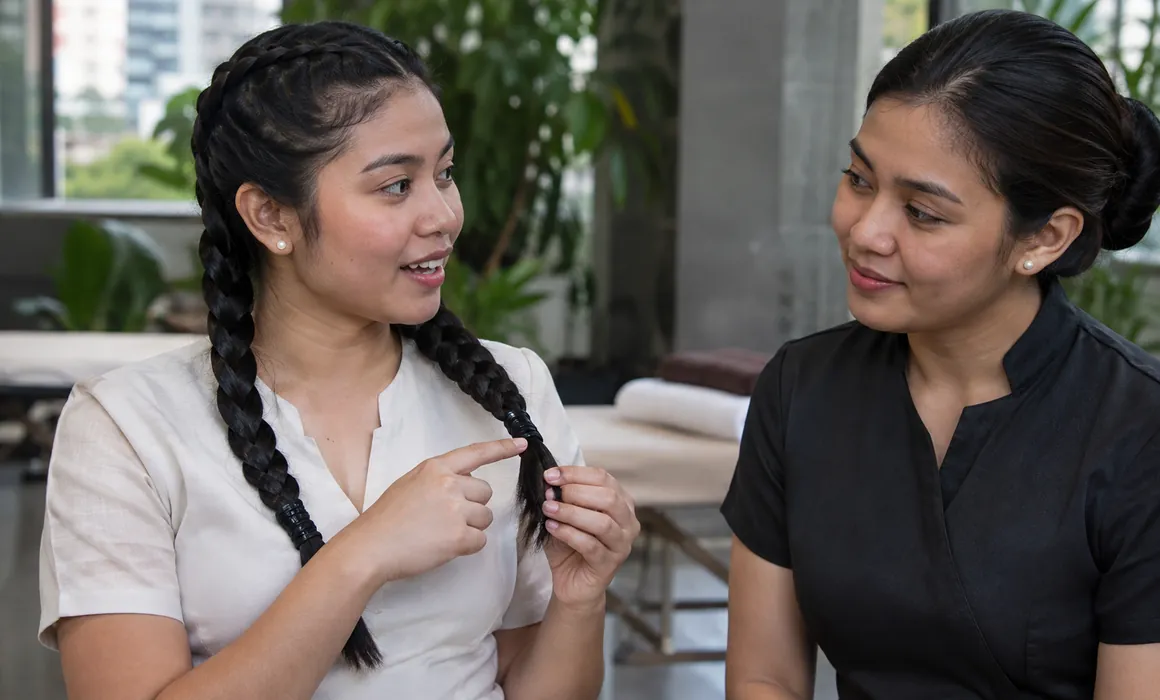
Point to sensitive edges, parts, sewn tracks, clips, or bonded sections yourself. You can use a mirror so you both know the area under discussion. No one needs to remove a covering or unfasten the style to test whether it will hold. For tight or painful hairstyles, the American Academy of Dermatology explains how repeated pulling affects hair. Massage should never be used to press through pain at a hairline.
Leaving braids intact for a family celebration
A client has an event in the afternoon and wants the relaxation of a head massage without loosening two face-framing braids. The concern is about the finished style, not scalp pain. She sits in front of a mirror, points out where the braids begin, and demonstrates which part of her head can rest comfortably on a pillow. The workable option may be a brief stationary contact at an open area or an entirely shoulder-focused visit.
- Can you keep the area above my ears dry from beginning to end? We can agree on the boundary before any shoulder cream comes out, and avoid returning an oily hand to your hair.
- If a pin catches on the headrest cover, who will remove it? We will stop and let you handle your own hair or remove the pin privately if you want it moved.
- What if I decide the whole style is too difficult to work around? We can leave your head alone and use the time on a different area you have agreed to include.
Hair that looks loose on the surface may be clipped or anchored underneath. The position of an attachment matters more than how a style looks in a photograph. A practitioner who asks where they can place a hand and waits for your direction can work around the information you choose to share.
Choose warmth, coverage, and access separately
A request for an extra sheet can mean several things. You might want more privacy, a warmer layer, or a clean barrier between skin and a piece of equipment. Say which problem you want the sheet to solve. A thin opaque covering may provide the privacy you want without unwanted heat. A blanket over clothing may be enough when the priority is a warmer room.
A client who wears a wrap over braids may want it to stay in place when another person enters the room. Ask before moving the wrap or the pillow beneath it. If the client wants to shift the fabric, give them privacy and a moment with a mirror, then confirm the boundary again.
At the end, check that a robe, wrap, or your own clothing is reachable before the sheet is removed. Feeling able to sit up and get dressed privately is as much a part of comfort as the way you were covered during the massage.
Distinguish skin contact from moving hair
Some people enjoy steady contact at an accessible part and dislike fingers combing from root to end. Others prefer the head left entirely alone but welcome contact on the upper shoulders. Explain which movement is off limits. “Please don’t run your fingers through the braids” is clearer than asking the therapist to be careful. The head massage guide describes the range of areas that providers may include under that name.
Work around a head covering without assuming it will come off
A scarf, bonnet, wrap, or other covering may protect a style, reflect a personal preference, or be part of how you dress. You can request shoulder or neck work without agreeing to uncover the hair. Explain whether the fabric can be touched, whether it must remain dry, and who will adjust it if the pillow pulls it out of place. You can leave the reason personal.
In a shared room or home with other people nearby, changing a covering may need more privacy than the therapist expects. If you would consider repositioning it, agree on a private place and a moment when you can do so yourself. Have a mirror available if it helps. A fully clothed, shoulder-focused appointment may be the simplest way to keep the covering and the style exactly as you want them.
Plan the contact a head support makes with your hair
Run through the positions you would actually use. A low braid may be comfortable against a chair back yet lie directly beneath your head on a treatment table. A clip that feels light while you are upright can become a hard edge when you rest against it. You can test these ordinary contacts without allowing anyone to undo a style or handle a sensitive part of the scalp.
An ornate braid can be comfortable against one side of a pillow and catch at the nape when you turn. Try the two positions you might actually use while the hair is still completely dry. If only one feels workable, say you want to keep that position or choose shoulder work facing forward.
If preserving a hairstyle is important for work or an event, think about the hour after the visit as well. A plan that protects the hairline while on the table can still be undermined by an oily pillowcase, product on your own hands, or a hurried change of clothes.
Plan for product transfer and the table
A dry scalp session still needs genuinely clean hands. Oil used on the shoulders can travel from fingertips to the roots or onto a pillow cover. Ask for hands to be cleaned before any move toward your head, or finish the scalp segment before other products come out. A high bun or thick knot at the back can also press against the table even if nobody touches the hair. Sit up to test another support or a different orientation.
Protect the part of your hairstyle that matters
| When this comes up | What to ask or do | Reason |
|---|---|---|
| Freshly secured braids | Point out tender edges and choose whether any scalp contact is welcome at all. | Appearance can hide where the style is under tension. |
| Clip-in attachments | Keep fingers from traveling through the lengths and around anchoring points. | A hand that slips easily through loose hair may catch on a concealed clip. |
| Product-free styling | Ask for scalp contact to come before oil work, or leave it out. | Clean hands and covers help prevent transfer even when the head itself receives no oil. |
| Bulky bun | Test the pillow arrangement while you can sit up and change your mind. | A pressure point can come from the support beneath a hairstyle without the therapist touching it. |
Pick a clean landing place for small belongings
Separate items you need during the appointment from those you only need afterward. A medical device controller or communication aid should remain usable. A watch or piece of jewelry may be better secured in your own bag. A wallet at the bottom of that bag can stay there until payment. This arrangement keeps you from asking someone else to search through personal belongings at an awkward moment.
If you remove pins, clips, or decorative pieces, keep them in a separate small container rather than folding them in the scarf you might put back on. A pin left in the fold can press into the scalp later and feel like tenderness from the massage when it is actually a hard object beneath the fabric.
Tell the practitioner which items must stay exactly where you placed them. Before leaving the room, check the one agreed storage spot and the area where you changed. A predictable routine is more useful than trying to remember several temporary places chosen while getting dressed.
Draw the edge of the area in ordinary language
A boundary also applies to the way the practitioner reaches the area. You may be happy for the hand to rest on one region while wanting the route to it kept clear. If a technique would require moving a sleeve, shifting a support, or crossing a sensitive patch, ask the practitioner to explain that first. A different approach or a smaller area might meet your goal without disturbing anything else.
Instead of listing every individual braid or extension, choose a boundary the practitioner can see without moving the hair. You might leave everything above the collar outside the service and keep a comfortable section of upper back available. A larger, simpler boundary is particularly helpful if the style must stay exactly as it is.
At a return visit, draw the line again if it matters. Bodies, clothes, and preferences change, and a note that says “shoulder work” cannot preserve the exact boundary you meant last time.
Give styling and scalp pain separate answers
If a hairstyle feels comfortable and you simply want it to last through an event, state that preference. If you have burning, tenderness, sores, or new hair loss, skip scalp work and consult an appropriate clinician. A massage appointment cannot determine the cause. You can ask Wellnessville about a shoulder-only visit and choose a product-free session if that better fits your plans.
Follow the product beyond the first application
A massage product can reach skin that the therapist did not intend to treat. A hand that has just worked on a shoulder can steady a pillow, shift a sheet, or brush a hairline. If keeping one place free of product is important, discuss how the therapist will change tasks. Hands can be cleaned, covers changed, or the product-free portion of the visit scheduled before any oils come out.
Oil can travel from shoulder work to a braid even if the therapist never intentionally oils the hair. A fingertip moving the towel at the neck, or a pillow cover used after the shoulders have been treated, can be the source. Decide whether to work product-free near the neckline or protect that entire region from contact.
Ask what you can use to remove excess product before handling glasses, a phone, a door handle, or your bag. A towel can absorb surface residue, while a person with a specific skin-care routine may prefer access to a sink. Plan the practical detail in advance if you need to drive, handle equipment, or return to work directly after the appointment.
Wording for a shoulder session that protects a style
My braids need to stay intact for an event. I’d like shoulder work with no oil or fingers through the hair, and I’ll adjust my own head covering if necessary. Can the therapist keep those boundaries during setup and when changing pillows?
You can send that message without sharing a photo. If the provider wants clarification, explain where the edges of the protected area are through ordinary landmarks. The ability to keep a scalp segment entirely optional often matters more than whether the menu formally lists a separate shoulder treatment.
Frequently Asked Questions
Can scalp massage loosen a freshly installed wig?
Contact can shift a wig or its attachments. Ask your stylist about your installation and leave the scalp out if you want the fit undisturbed.
Do I need to shampoo immediately before a scalp session?
There is no universal shampoo schedule for booking. Follow your normal scalp care or stylist’s instructions and check any venue requirements.
Can I bring my stylist’s instructions?
Yes. A short written note on which attachments to avoid can be helpful if you choose to share it.
Can a friend translate the name of my hairstyle?
Yes, if you want that help. A photo of your own finished style can also identify it without specialized vocabulary.
Will the provider redo my braids after the session?
Hair styling is a separate service. Confirm availability elsewhere if you need a style refreshed after your visit.
Try Our Massage Packages
Some of Our Massage Therapists