










Plus-Size Massage: Questions About Table Width, Support, and Fit
A plus-size massage should begin with reliable information about the actual table, the available width, and the room around it. The stated working capacity, usable surface, and your preferred position all matter. A reassuring “we accommodate everyone” does not answer whether your arms will be supported or whether there is enough room for you to get on from the side you prefer.
Ask for the usable surface, not just a product name
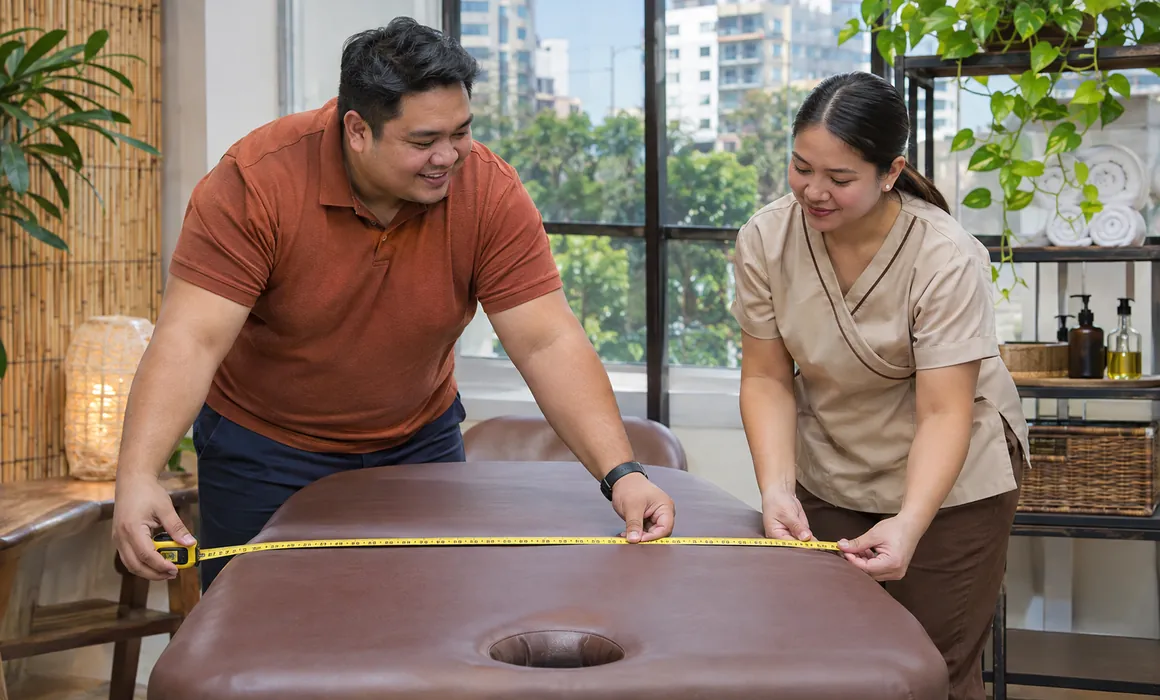
Find out the width of the padded surface and whether arm supports or extensions are available and rated for that model. A number on paper may make more sense when compared with a familiar bench or mattress. Width matters beyond fitting your torso. You may want both arms supported without tucking them underneath you. Ask how the provider checks the manufacturer’s working capacity for the exact setup.
Check the furniture as separate items
| What you notice | A practical next step | What this clarifies |
|---|---|---|
| Treatment table | Confirm usable width and the manufacturer’s working capacity for the installed setup. | Both the safe load and the available support surface affect fit. |
| Changing chair | Ask about seat width, armrests, and stability based on your own preferences. | A good treatment table does not make a poorly fitting chair comfortable. |
| Linens | Ask how the sheet stays secure during a turn and whether a second cover is available. | Enough coverage in a still position may be insufficient while rolling. |
| Floor space | Check the clear approach from the side you use to get on and off. | The physical table number tells you nothing about a cabinet blocking the approach. |
Include the few minutes spent getting dressed
Work backward from the moment you need to leave. Which clothes can you put on comfortably, where will your shoes be, and will you want to sit down before standing? These details are easy to overlook in an appointment description that begins when the therapist’s hands touch and ends when they stop. They can matter a great deal when time, balance, fine hand control, or fatigue is a consideration.
Before getting on the table, locate a seat where you can sit and reach your own clothes. An ordinary robe might be suitable, or you may prefer your own loose-fitting clothing. Decide which items the venue can supply in a fit you like and which you would rather manage yourself.
Allow time for any skin product to be removed from your hands before you handle a device, a fastening, or delicate equipment. A calm end is easier to plan before the session begins than when the next client is already waiting outside.
Include the approach, the step, and the turn
Can you reach the table from both sides? Can it be lowered? Is the changing chair sturdy, comfortable, and free of narrow fixed arms if that’s what you need? Describe the space required to turn or sit up. The accessible massage guide helps you check the entire route without asking a receptionist to guess what will feel comfortable to you.
When the capacity is adequate but the width is wrong
A branch confirms that its table can support a client’s weight. On arrival he discovers that the surface is too narrow for him to rest both forearms comfortably. The first answer was accurate but incomplete. He needs usable width, support for the arms, and a way to shift position comfortably. The provider checks the exact model and its accessories. If the setup cannot accommodate him with dignity, he can leave without agreeing to balance on an edge.
- Can you give the padded width without counting an unattached accessory? We can measure the usable surface and tell you which manufacturer-approved supports are actually available that day.
- If you need a measurement from me, can we handle it in private? We can discuss why it affects the setup, what information is sufficient, and who needs to see it.
- Is there room to step up from the side I normally use? We can check the clear floor space, table height, and route around the furniture before confirming the room.
A robe size on a website tells you almost nothing about the width of a chair or a treatment table. Ask for information that matches the part of the visit you are deciding about. If the spa can provide a suitable table but cannot provide a comfortable robe, you might choose your own clothing. If the table itself is unsuitable, clothing cannot solve it.
Check the setup that will actually arrive
A photograph on a booking page may show a branch table while the appointment you want uses portable equipment. Ask which table or chair is assigned to your visit, whether the head support adjusts, and which accessories are available. A promise that the business owns an item does not necessarily confirm that it travels with your particular practitioner.
Ask separately for the manufacturer’s working capacity, the usable tabletop width, and the rating of any added arm supports. A standard number quoted for the center of a table cannot describe every accessory. Clear figures give you the option to compare the setup privately before deciding to travel.
Think about where the equipment will stand. The practitioner needs a clear approach to the agreed body areas, and you need room on the side where you will get on and off. Check door swing, a nearby cabinet, and whether a chair for dressing will still fit after the table is open. A room can look spacious until the furniture takes up its working footprint.
Treat draping and clothing as matters of fit
An opaque sheet that covers you securely in one position can pull short when you roll onto your side. Ask about the actual linen size and how the therapist handles turns. You can ask for an additional sheet, work through clothing, or a different initial position. The quantity of body area uncovered does not determine the value of the appointment. You can choose the coverage you prefer and still expect thoughtful treatment.
Width, support, and privacy can change independently
A wide table may still have a narrow face support. An approved extension may support an arm yet leave the approach to the table awkward. A room with excellent equipment may offer sheets or gowns that feel insecure in a side-lying position. When you ask, ask about the two or three components that determine whether a visit will feel comfortable to you personally. You do not need to ask every possible question.
If you choose to share a measurement, agree on what it means. Hip width while seated, the span of your arms when resting, and total body weight answer different equipment questions. A provider can often give you the manufacturer’s usable dimensions and working limits first, allowing you to compare them privately. If the provider needs more information for safe use, the conversation should be specific, respectful, and handled away from a public reception desk.
Choose warmth, coverage, and access separately
A request for an extra sheet can mean several things. You might want more privacy, a warmer layer, or a clean barrier between skin and a piece of equipment. Say which problem you want the sheet to solve. A thin opaque covering may provide the privacy you want without unwanted heat. A blanket over clothing may be enough when the priority is a warmer room.
A second covering can be useful where the sheet remains secure while still but shifts when you turn. Ask to check coverage while fully dressed if you wish. The practical test is whether you can move comfortably while retaining the privacy you want, not whether a particular linen is labeled large or extra large.
Ask which area the practitioner needs to access for the part of the session you have chosen. If you want everything else to remain covered, agree on how the edge will be held, especially when a support or garment moves. You may prefer to adjust your own clothes while the therapist steps away. Treat that time as an ordinary part of the appointment.
Make an ordinary dry run before anyone introduces a product
A short dry run can reveal problems that a verbal description misses. Choose the position, place the supports, set down belongings, and see whether communication still works. Nobody needs to apply oil, expose an area, or start massage during this check. You are deciding whether the arrangement fits the person in front of the practitioner.
Try the part of the setup that matters most before the therapist begins. Does your forearm actually rest on the available extension? Can you turn without feeling close to the edge? Is there a clear space on the side where you get up? Checking those details while dressed keeps the decision under your control.
During the trial, notice whether a sleeve pulls, a cushion blocks a route, or a signal is no longer visible. Ask for the adjustment you want and check it again in the same position. If it takes several changes just to remain comfortable, consider whether a simpler seated or clothed session would make more sense, provided it fits your needs.
Give the provider a chance to check facts privately
If the person taking the call doesn’t know the working capacity, ask them to check the documentation and reply before you travel. You can request a private conversation if a personal measurement is genuinely needed. A home massage setup may use different equipment from a branch. Confirm which table will actually arrive. The Wellnessville contact page lets you check fit and availability before committing to a visit.
Ask for a quote that describes the same experience
A useful price comparison has a common unit. Find out whether the figure applies to one person, a pair, an instructor, a particular length of time, or a visit that includes equipment and travel. A smaller headline figure can cover a different activity altogether. Ask for the actual service and the total payable in Philippine pesos before you attach value to the number.
Verify whether equipment confirmed for your fit is part of the service at the quoted price and whether using a different room changes the charge. Do not infer a policy from a promotional photograph. An actual quote for the correct room, table, and visit gives you a fair basis for comparing providers.
Separate required charges from optional choices. You may be comparing a location fee, a longer booking, an instructional add-on, or supplies. Ask whether each item is necessary for your chosen arrangement and whether you must decide about it at booking. A clear quote leaves you able to decline extras without having to reconstruct an unfamiliar price list in the treatment room.
Wording for checking table and room fit
Could you confirm the working capacity and usable padded width of the table for my booking, plus any approved arm supports? I’d like a stable changing chair, secure coverage during a turn, and space to approach the table from my preferred side.
If the provider replies with a brand name, ask for the actual model or verified measurements. You can often compare those privately without sharing personal dimensions. If the assigned equipment changes, decide again using the information for the actual setup.
Frequently Asked Questions
Does static load capacity mean the same thing as working capacity?
No. A static test figure alone cannot determine the safe working capacity during a session. Use the manufacturer’s rating for the actual configuration.
Can I ask for the table width in centimeters instead of inches?
Yes. Ask for the units alongside the measurement. One inch is exactly 2.54 centimeters.
Can I request weight-neutral conversation?
Yes. You can ask the practitioner to keep the discussion on comfort and agreed care and to leave weight-loss advice out.
Do I need to supply a full-length photograph to ask about equipment?
You can start by requesting the equipment specifications. Ask why any photograph would be needed before sharing personal information.
Do table extensions always add the same usable width?
No. Dimensions and permitted uses differ by model. Request the manufacturer’s specifications for the exact extension offered.
Try Our Massage Packages
Some of Our Massage Therapists