

















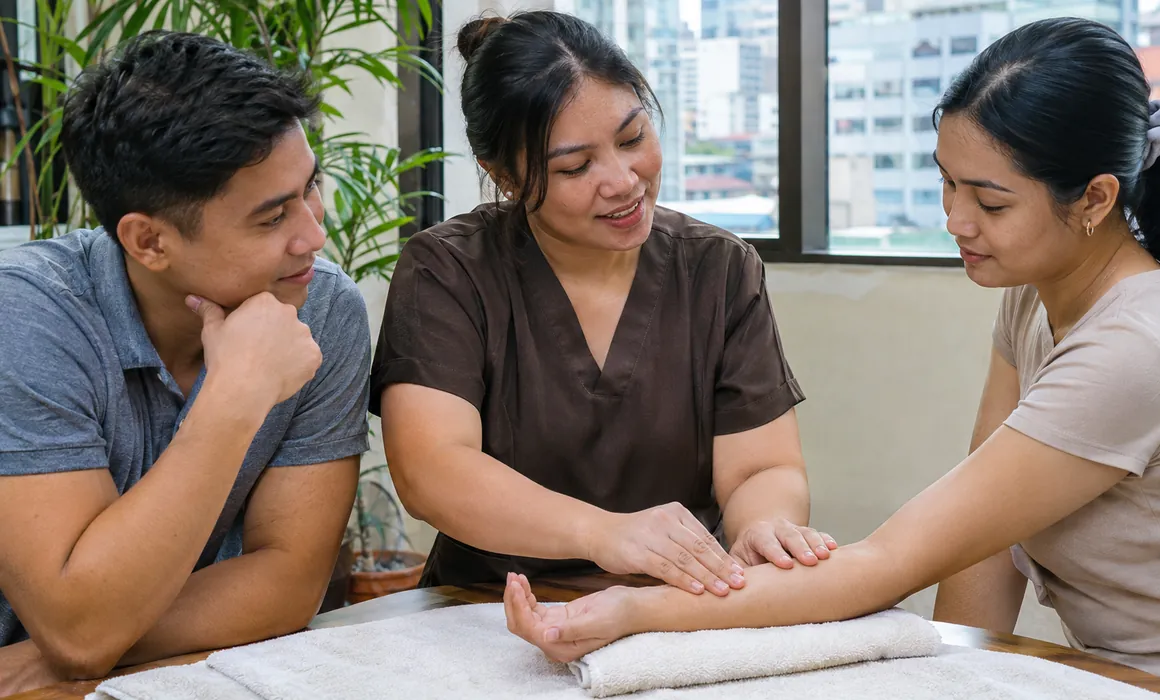
Partner Massage Class or Couples Massage? Choosing the Right Experience
A partner massage class and a couples massage can both involve two people, yet the afternoon looks very different. In a class, the couple hopes to learn from an instructor and may take turns giving and receiving simple, agreed contact. In a couples massage, both people usually receive a professional service. Before buying a gift or choosing a date, ask whether the booking is for learning, receiving, or a clearly described combination.
Decide what each person wants to leave with
One partner may picture a quiet hour lying down while the other imagines learning a skill to use at home. Ask separately. If one person doesn’t want to practice touching a partner in front of anyone, a class may be a poor surprise. The guide to couples massage explains how two recipients can choose individual pressure and coverage within a shared booking.
A birthday gift with two different expectations
One partner buys a Saturday experience picturing a quiet couples session. The other is eager to learn a simple way to give a hand massage. A listing that says “partner experience” leaves both guessing. They ask who gives the contact, who receives it, and who teaches. The answer reveals a small-group class with practice in pairs. They can now decide whether they both want that public learning experience or would prefer two professional appointments.
- Will an instructor coach each person or will two therapists provide the massage? Ask the organizer for the actual sequence, who is staffed, and how two participants spend their time.
- What if I prefer to observe the demonstration and skip giving contact? Check whether observation is an option and whether your partner can participate without being pressured to model.
- Do we both need to share our comfort limits in front of the group? Ask about private communication with the instructor, clothing, and how a participant can decline a practice activity.
A class can build confidence when it teaches a small, clearly bounded skill and lets people practice communication as much as movement. A couples service can offer an enjoyable shared setting without making either person perform. Thinking about how you want to spend the hour is more informative than comparing photographs of two people smiling in a spa.
Read the part of a package that determines whether you can use it
Before paying for several visits together, look at expiry, transfer, cancellation, and the services the package actually includes. Count the visits you reasonably expect to use, not the number you could theoretically fit into an ideal month. An offer tied to one practitioner or branch may be an entirely different purchase from one redeemable at several locations.
For a workshop voucher, find out whether both participants must attend the same date and whether a substitute partner is permitted. For a couples service, check whether changing one person’s time changes the whole reservation. An offer can be generous but difficult to redeem if its terms do not fit both calendars.
A flexible booking is particularly important when the visit depends on health, a work roster, an interpreter, or the plans of a second person. Ask what happens to the remaining balance if a necessary arrangement is unavailable. Does the issuer offer a replacement service, a new date, a transfer, or a refund? Record the answer accurately rather than assuming every provider uses the same terms.
Ask how the instructor teaches
A useful class description tells you the skill level, whether practice happens through clothing, what contact the instructor demonstrates, and how either partner can opt out. An instructor can demonstrate on their own forearm or a willing model. No participant should become the class example by default. Ask whether the room is private to your pair or shared with other learners, and whether you can observe rather than take a turn.
Choose a class by what you can practice with permission
A partner may want to learn where to place a hand, while the other wants to get better at explaining what feels comfortable. A good beginner activity can accommodate both aims through simple, optional contact and time to talk. Ask whether the instructor gives both people a turn to decide what will be demonstrated. If the course is tightly choreographed and there is no room to decline a region, it may not fit the learning experience you pictured.
A class whose title promises advanced clinical techniques deserves different scrutiny from a class intended for everyday comfort. Find out who teaches it, what prior knowledge is expected, and what support is available afterward. For a personal gift, a straightforward lesson with a clearly limited aim may be more usable than an impressive list of maneuvers neither participant is prepared to use responsibly.
Find out what an instructor will actually observe
When the purpose is learning, ask what the instructor will watch you do and what kind of feedback they can give. A useful beginner activity has a clear starting position, an easy way to stop, and one skill you can describe afterward. Watching a demonstration in a crowded room and receiving individual coaching are different learning experiences, even if both are sold under the same workshop name.
Ask whether a beginner class includes time to practice the skill under observation or is primarily a demonstration. If you are buying it for someone who wants feedback on hand placement, that distinction determines whether the class offers what they want. A quiet couples treatment does not normally provide a teaching opportunity.
Ask what the lesson does and does not qualify a learner to do afterward. Learning a simple, comfortable action for personal use is very different from diagnosing another person’s symptoms or offering professional treatment. A good description makes those boundaries easy to understand.
Make the preview small enough to change your mind
A demonstration works best when it answers one question. Choose an easy-to-reach region where contact is welcome, keep your clothing as you prefer, and ask the therapist to describe what the demonstration will involve. You might watch the first contact and then close your eyes to notice the sensation. You can also ask to see the movement on a folded towel without any contact on your body. A preview gives you information whether or not you decide to continue.
A beginner demonstration should have a clear beginning and end. The instructor can show a simple contact on their own arm or with a consenting participant, then give each person a chance to choose whether to practice. An example does not entitle anyone to continue hands-on work with a learner who wants to watch.
Give the demonstration an end. Agree that the practitioner will do one brief example, take their hands away, and wait. Without that break it is surprisingly easy to find that a sample has become several minutes of treatment. Use the moment without contact to say what you liked, what felt odd, or that you would rather try something entirely different.
Keep learning within a beginner’s scope
A class for home comfort should avoid encouraging forceful neck work, manipulation, or treatment of injuries. Ask what guidance accompanies any demonstration, when participants should stop, and where to direct medical questions. Following a clinician’s specific rehabilitation plan is different from attending a casual class. Receiving a demonstration does not qualify someone to practice professionally or diagnose a partner’s pain.
Compare what the two people will do
| When this comes up | What to ask or do | Reason |
|---|---|---|
| Giving or receiving | Ask who provides contact during the advertised experience. | The term partner may refer to the fellow learner or to the person receiving a second professional massage. |
| Separate or shared space | Ask whether others attend the class and where the practice occurs. | A gift that feels private to the purchaser may in fact be a group lesson. |
| Learning objective | Ask what a beginner should be able to explain or do after the lesson. | A specific learning aim is more useful than a promise to master professional techniques. |
| Option to observe | Confirm whether either member of the pair can opt out of a practice. | An invitation to learn together should leave each person control over participation. |
Give each person a separate answer
When two people book together, it is tempting to ask for one preference that covers both. It rarely does. Each person may want a different amount of touch, a different degree of conversation, a different setting, or a different role in the activity. Give both a chance to answer privately if the choice concerns comfort or personal information.
A participant can want to learn while preferring not to act as the instructor’s demonstration model. Check that both members of the pair can make that choice separately. Choosing a class together does not require two adults to accept identical contact, exposure, or levels of participation in front of a group.
A shared room or time slot also creates practical trade-offs. One person may want music while the other needs quiet. One may wish to remain clothed or observe while a companion still wants to take part. Ask the provider which differences it can accommodate within the same booking and which would require separate rooms, practitioners, or times.
Have a fallback for a change of room or practitioner
An appointment can be correctly booked and still change on the day. A portable table may be unavailable, a different practitioner may cover a shift, or a room that was supposed to be quiet may be in use. Identify the one or two conditions that determine whether you can proceed. Tell the provider which substitutions are acceptable and which require a conversation with you first.
If the booked instructor is unavailable, ask whether the substitute is qualified to teach the activity you chose. An available massage therapist may be well suited to giving two appointments without offering the same lesson. Agree on a substitution only after both participants understand what experience will now be provided.
If the arrangement changes on arrival, stay dressed while you assess it. Ask for the accurate details and compare them with the original request. You might be able to use a different position, wait for the right room, or move to another day. There is no need to start the session just because the provider has already opened the room.
Check the booking details separately
Some venues offer professional couples sessions but no instruction. Others run classes only on certain dates. Confirm instructor availability, materials, language, total price for two, and whether both people need to attend the whole class. The massage gift guide can help if you want to leave the choice open. Ask Wellnessville about current offerings rather than assuming that a couples appointment includes teaching.
Ask for a quote that describes the same experience
Separate required charges from optional choices. You may be comparing a location fee, a longer booking, an instructional add-on, or supplies. Ask whether each item is necessary for your chosen arrangement and whether you must decide about it at booking. A clear quote leaves you able to decline extras without having to reconstruct an unfamiliar price list in the treatment room.
Ask whether the displayed price buys one class place, two places in a group, private instruction for the pair, or two professional massage sessions. These are different products. A clear total and a description of staff and room time give you a more meaningful comparison than the word couples on a menu.
Keep the confirmation with the appointment details. If something changes, refer to the original wording and ask what new amount applies before agreeing. This approach is fair to the provider as well as the client because both can point to the same description of what was actually requested.
Wording for checking a partner learning experience
We are deciding between a beginner class and receiving massage together. Could you tell us who gives the massage, whether we practice in front of other people, and whether either person can observe instead? Please quote the full price for both adults.
A reply with a class schedule and two places confirms something different from a reply with two therapists and side-by-side appointments. Clarify the nature of the experience before buying it for someone else, particularly when the recipient may prefer quiet rest to group participation.
Frequently Asked Questions
Do we have to supply a portable table for a partner class?
Ask what equipment is supplied and what learners should bring. Venue-based and home classes can differ.
Can two friends attend a workshop marketed to partners?
Ask the organizer about eligibility. Explain that two adults wish to learn together.
May I film the instructor’s demonstration for personal reference?
Get explicit permission from the instructor and everyone who might appear in the recording.
Can an instructor provide a large-print class handout?
Ask in advance about print size or an accessible digital handout so the instructor can confirm what is available.
What if only one ticket is transferable?
Check the provider’s written rules for the pair before giving or selling either place to someone else.