















Massage Draping: How Coverage Works When You Turn or Change Positions
Massage draping is the use of clothing, sheets, or towels to maintain privacy during treatment. A clear arrangement answers a simple question before anyone touches a sheet: exactly which area will be uncovered, for what purpose, and for how long? The client can choose more coverage, ask for work through clothing, or exclude an area altogether.
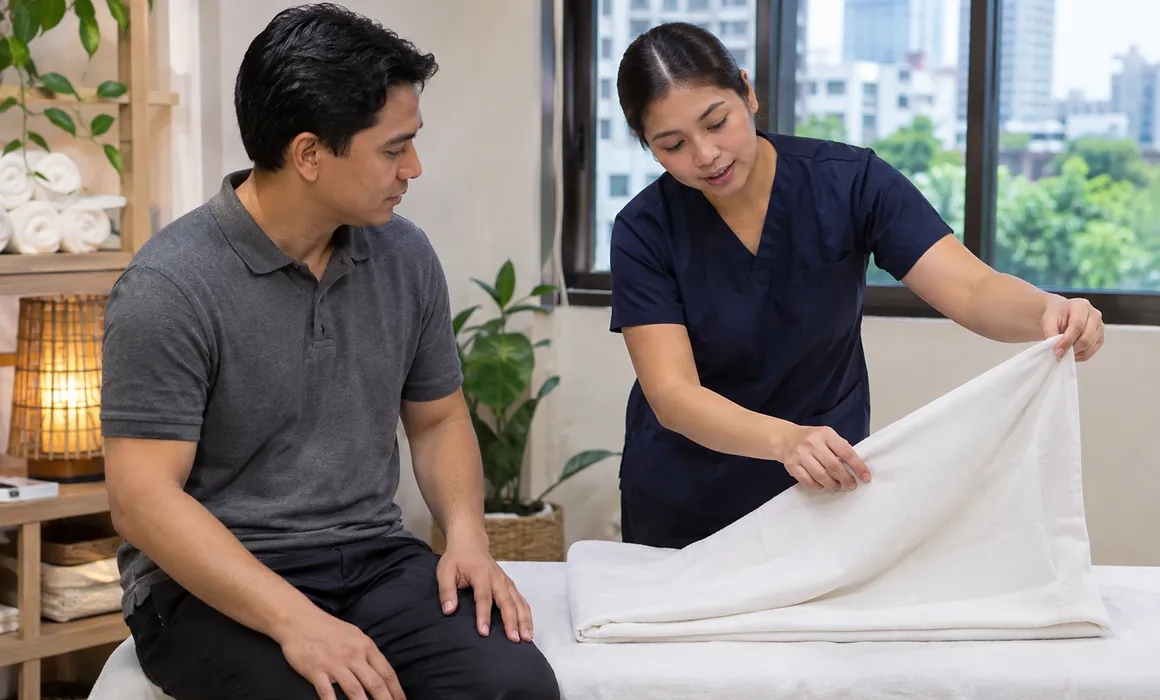
A change of position deserves as much attention as the first few minutes. The most practical time to ask how a turn works is while you’re sitting up and fully dressed. That lets the therapist demonstrate with an empty table and a spare sheet rather than trying to explain from behind you.
Agree on the boundary before unfolding a sheet
Show the therapist the area you want included over your own clothing, if that feels comfortable. You might ask for work from the shoulder to the elbow with the rest of the upper body covered. The edge of the sheet can mark the boundary. Agree on whether treatment will happen through fabric or on skin. Consent to one does not automatically extend to the other. The first massage appointment guide covers the broader intake conversation.
How to handle work near the edge of a covered area
A client may want contact on the upper back while asking that a neckline or bra strap stay exactly where it is. The practitioner can explain how much of the agreed area is reachable with the garment in place. If the garment limits access, the next decision belongs to the client. They can choose a smaller working area, work through fabric, adjust their own clothing privately, or end that part of the session.
For the same reason, a practitioner should discuss moving a sheet even when the new area seems close to the old one. A few centimeters can be the difference between two very different personal boundaries. Describe your boundary using a landmark you can both identify over the garment. “Stay on the shoulder side of this seam” can be easier to follow than the general request to keep everything modest.
Decide what belongs in a private conversation
Before sending a document or photograph, ask what decision it would inform and who would see it. If the practical instruction can be communicated in a short note, that may be enough. When clinical information is essential, use a method you and the care team consider appropriate. A group booking thread is usually a poor place for an individual’s medical or personal history.
Coverage requests can be recorded in purely practical words. “Keep the abdomen covered and ask before adjusting sleeves” gives the next practitioner a usable instruction. You do not need to attach an account of a past experience for that request to deserve attention, particularly in a shared booking conversation.
If someone else arranged the appointment, keep payment and personal information separate. A friend may need to know when to pick you up. That does not mean they need a description of what you discussed with the therapist or which areas you chose to leave covered.
Understand the order of an ordinary turn
The practitioner can stop, tell you which way they are asking you to turn, secure the drape, and wait while you move. Ask for privacy to reposition clothing or get comfortable. If the sheet catches beneath your hip, pause. You can hold an edge yourself, ask for a second covering, or sit up instead. A turn can take the time it takes. The session should resume only after you confirm that the coverage feels right.
Compare coverage choices before you change
| Situation | What to do | Why it matters |
|---|---|---|
| Over a shirt | Agree on the area and how sleeves or collars will be handled. | Leaving clothing on does not give permission to move underneath it or shift a garment unexpectedly. |
| One arm uncovered | Name the area to expose and check that it will be covered before the next area is discussed. | This keeps access to a small area from silently becoming permission for wider exposure. |
| Turning over | Settle on a sheet-holding plan and a cue that you are ready. | An agreed pause allows the recipient to correct a trapped edge or adjust clothing privately. |
| Ending the service | Ask where the robe or clothes will be and how the therapist will leave. | Privacy still matters after hands-on contact stops, while you are sitting up and dressing. |
Choose warmth, coverage, and access separately
Ask which area the practitioner needs to access for the part of the session you have chosen. If you want everything else to remain covered, agree on how the edge will be held, especially when a support or garment moves. You may prefer to adjust your own clothes while the therapist steps away. Treat that time as an ordinary part of the appointment.
For upper-back work, you can agree to leave the front of the body and the lower back covered even if the garment or sheet could be moved farther. Show the boundary over your clothes and ask the practitioner to describe how the sheet stays secure as they change sides of the table.
At the end, check that a robe, wrap, or your own clothing is reachable before the sheet is removed. Feeling able to sit up and get dressed privately is as much a part of comfort as the way you were covered during the massage.
Keep clothing as an active choice
Someone who likes massage over a shirt may still want a blanket for warmth. Someone comfortable with a bare forearm may want to keep sleeves elsewhere. These are ordinary choices within professional care. They apply independently to each area of the body. If you prefer clothed options, the guide to dry massage explains how work through fabric can feel.
A turn that stops halfway
During a planned turn from face down to face up, a corner of the sheet catches under a client’s hip. Continuing would pull the covering tighter instead of giving it enough slack. The client asks to stop halfway. The practitioner secures the visible edge, asks whether another covering would help, and waits. The important decision is when the client feels covered enough to finish the turn. It does not depend on getting the movement right the first time.
- Could you demonstrate the fold without touching my clothing? We can show it on the empty table and agree on the parts that will stay covered throughout.
- Can I hold this edge while I roll, then adjust my shirt in private? We can stop contact, make sure the covering is secure, and give you the privacy you request.
- How will you know I’m ready after I’ve changed? We can choose a spoken cue or another signal and wait until you give it before returning to the table.
In a home visit, closing a bedroom door may still leave someone in the household likely to knock or walk in. Decide who will respond to an interruption while the recipient is covered and the practitioner is ready to pause. This is a practical privacy detail even when everyone in the home already knows the appointment is taking place.
Set up a private room people can still reach appropriately
Position a changing chair or a place for clothing away from the direct line of sight through an opening door. Check what a mirror or video call could reveal. If you use a phone or tablet for interpretation or communication, keep it accessible while protecting any moment of undressing. Agree on when a companion should step out and who can come back in.
A home visit may use a room with a direct line of sight from the hall when the door opens. Standing by the table fully dressed, check what another person would see from that doorway. Move the changing chair or agree who will answer a knock before anyone relies on a sheet for privacy.
A client should be able to end the appointment and use the room independently afterward. Leave a clear path to belongings and the exit, and explain any change to the furniture before someone stands. Privacy and practical access work best when both are considered before the equipment is set out.
Think about what fabric does between hand and skin
For work through clothing, think about where zippers, hooks, pockets, and thick stitching meet the table as well as where the therapist will place their hands. A fastening that is harmless while standing can become a pressure point when you lie on it. A change of position or a different garment may solve the issue without asking you to remove an item you want to keep on.
If you wear a top with a loose neckline, look at how the fabric falls while you are lying on your side. A shirt that feels secure on a chair can gape while rolling. You can add a separate cover or adjust your own clothing before continuing with work near the shoulder.
There is no ideal outfit that suits every massage. Choose clothing you can manage independently, that stays where you want it during a position change, and that allows the particular contact you have agreed to receive.
Recognize a respectful response
A practitioner should be able to explain a boundary without teasing, bargaining, or suggesting that exposure proves trust. A written form can record a conversation, but it cannot answer a new question on your behalf. For an example of published professional expectations, see the Ontario massage regulator’s standard on draping and physical privacy. It offers readers a practical comparison when asking about a provider’s own policy. Use Wellnessville’s contact page to clarify available arrangements in advance.
Set the rules for a change of activity
Decide what should happen when an answer is unclear. The safest communication default is a pause. If you did not hear a question or do not know what a word means, the therapist can take their hands away, rephrase the proposal, and let you decide without simultaneous contact. A nod to an earlier activity should not be carried forward to everything on the menu.
Before rolling over, agree on two signals instead of one. The first means you are ready to move; the second means you are settled and ready for contact to resume. That difference leaves a protected moment to adjust the sheet, find the pillow, or decide that the new position is not comfortable.
At the end of the visit, tell the practitioner which cues were helpful. A concise note about when you need advance notice can preserve quiet time at a future appointment without asking you to explain the whole arrangement again.
Wording for a clear coverage agreement
I’d like to keep my lower body covered throughout. Before I change, could the therapist show how the sheet will be held if I turn and tell me where my robe can stay? Please ask before shifting any part of my clothing.
A provider who understands the request can confirm the sequence from changing to dressing. If the response focuses only on whether underwear is permitted, repeat the part about covering during movement. The two questions are related, but a choice of underwear does not answer what happens to a sheet or a garment during a turn.
Frequently Asked Questions
Can I request a different practitioner after a coverage concern?
Yes. Contact the provider, describe what you need, and ask about available practitioners or other next steps.
Does a disposable garment replace the need to explain coverage?
No. Even when garments are offered, the therapist should explain how clothing, draping, and touch will work together.
Are photographs part of routine draping?
No photography should be assumed. Recording or taking pictures is a separate decision requiring specific permission.
Can I bring a support person to a consultation about a past incident?
Ask the provider about having a trusted person present and where a private conversation can take place.
What if the provider’s standard robe does not close comfortably?
Ask for a different size or a second clean covering before changing. You may also keep on your own clothes.
Try Our Massage Packages
Some of Our Massage Therapists