















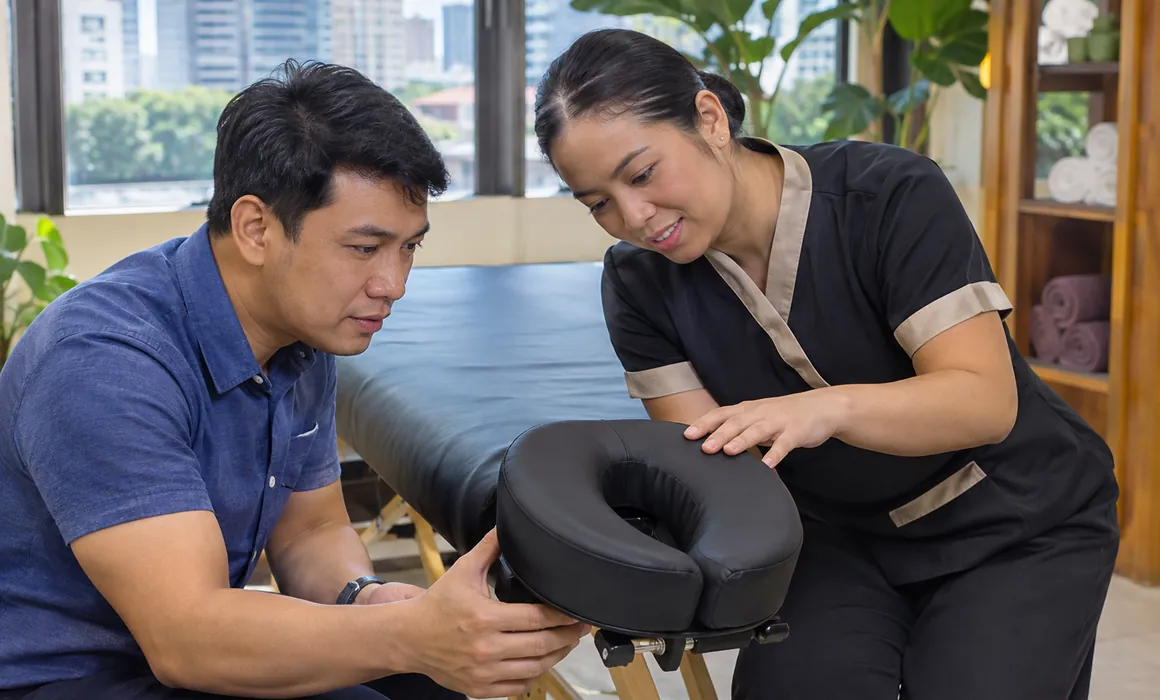
Massage Face Cradle Fit: Fixing Forehead, Jaw, and Sinus Pressure
A massage face cradle is the padded, U-shaped support at the end of a table. When the fit works, your face rests on the cushion and you can breathe and speak easily through the opening. When the fit is off, ten minutes can feel very long. A crease across your forehead, a crowded nose, or pressure on your jaw gives you a concrete reason to pause and adjust.
Fit the cradle while you can still give directions
Ask to try it before oil goes on or the room goes quiet. Stand where you can see how the opening lines up with the table, then lie down at your own pace. If you seem to be searching for the hole with your nose, lift your head and start over with the therapist’s help. The useful adjustments are where the padded pieces meet your face, the angle of the support, and its height relative to the table. Let the practitioner adjust and secure the hardware while your weight is off it.
Notice which part of your face touches first. If your forehead takes nearly all the load, describe that. If your jaw pushes backward or a cheek feels compressed, name the exact spot. A client saying “It feels odd” may get a thicker towel when what they needed was a different angle. Ask to retest the fit in the same position before setting your arms down again.
The nose opening is clear but the jaw still feels crowded
Imagine you can breathe through the opening but keep catching yourself clenching your teeth. You mention feeling stuffy and the therapist turns on a fan. The air is cooler, yet the discomfort remains. When you sit up and show where the cushion presses under your cheek, the conversation changes from room ventilation to the fit of the support. You can now compare the cushion with a side-lying position before resuming any contact.
- Can I see the face cradle fitted to the table while I’m sitting up? We can show you the angle, the opening, and the cover so you can point out what is bothering you.
- Could I lift my head while you change the height? Yes. We can keep the support unloaded during adjustment, lock it, and invite you to try it again.
- If my jaw still feels compressed, what would we do about the back work? We can discuss working with you on your side or seated, and say which areas are practical to reach in that position.
A cradle that fits you on one table may feel different when the whole table has a thicker pad. Your head’s position relative to your chest has changed even if the face cushion looks identical. This matters when a home visit uses a different portable setup from the branch where you had a comfortable session.
Consider what gets compressed when you lie down
Somebody looking at a treatment table sees a broad, flat surface. Somebody lying on it can feel every place where an ear, chin, elbow, hip, accessory, or device meets that surface. An area can become uncomfortable without receiving any massage at all. Before choosing where hands-on work will happen, check which regions the position itself will load.
If an adjustment relieves forehead pressure but now presses the chin backward, several parts of your face are competing for a small surface. Use that observation to discuss a position that leaves your face entirely clear. A supported side position can be a better trial than adding another layer to a cushion you cannot comfortably settle into.
Recheck when an extra pillow or folded sheet is added. It can take pressure off one place and direct it toward another. Describe the new point of contact if the first adjustment did not solve the problem. A small, carefully placed support can be more effective than piling on cushions without checking how the weight falls.
Check the cover and the air space
A disposable cover or soft linen can fold into the opening. It may brush your lips or make the space feel stuffy even when the frame fits. Lift your head and ask the practitioner to reposition the material. Fresh covers matter, too. The spa hygiene checklist gives you words to ask about surfaces and linens without making assumptions about what has been changed.
Why raising the table and changing the cradle are separate adjustments
A portable table can sometimes be raised or lowered to suit the practitioner’s working height. That does not automatically alter the relationship between the face support and your shoulders. Similarly, making the face cushion softer does not necessarily open space for the nose or remove pressure from the jaw. Tell the practitioner where your weight is falling, then ask them which actual adjustment might change it. Try the adjustment before introducing another.
If a table has a fixed opening instead of a separate cradle, the available choices may be more limited. Ask to see it and find out whether a side-lying or seated position is possible. In particular, do not try to solve a blocked or uncomfortable opening by burying your face deeper into a stack of cushions. You should have a clear air space and an easy way to speak or sit up.
Check the setup that will actually arrive
A photograph on a booking page may show a branch table while the appointment you want uses portable equipment. Ask which table or chair is assigned to your visit, whether the head support adjusts, and which accessories are available. A promise that the business owns an item does not necessarily confirm that it travels with your particular practitioner.
When asking about portable equipment, distinguish a central opening cut into the tabletop from an adjustable U-shaped attachment extending beyond it. A picture of a cushion alone may not show which one is provided. Ask the person setting up the table to explain what can be changed at that visit.
If your willingness to book depends on a particular adjustment, ask for confirmation before the visit. When the provider cannot verify the promised setup, wait for the information, use a location the provider can verify, or choose a plan that works with a simpler arrangement.
Plan an exit from face-down work
If your nose feels blocked or the pressure returns, ask to turn onto your side or sit up. There is no advantage to quietly counting down the minutes. A shorter stretch face down followed by another position may work better than repeatedly readjusting. Tell the therapist if you have a recent eye, sinus, dental, or facial procedure and follow the treating clinician’s advice about face-down positions.
Use the location of pressure to guide the conversation
| When this comes up | What to ask or do | Reason |
|---|---|---|
| Forehead bears the load | Lift your head and show where the cushion makes first contact. | Checking the angle and pad position is more informative than assuming that an extra layer is needed. |
| Nose feels crowded | Ask to inspect the opening and any linen that folds across it. | A fabric fold and a support that does not fit require different adjustments. |
| Jaw wants to clench | Pause and check the support under the cheeks and jaw before continuing. | This gives you room to choose a different position without repeatedly testing a painful fit. |
| Pressure returns later | Agree on an easy way to sit up and switch positions. | A support can be acceptable during a brief test yet uncomfortable after time in the same posture. |
Check the surfaces underneath as well as on top
At a home visit, distinguish the covering that protects the household surface from the clean linen that contacts your skin. Ask what the therapist supplies and what the household is expected to prepare. Keep used towels separate from the clean stack. A clean-looking fold is not evidence that a piece of linen has been changed between clients.
Before lying face down, look at how the cover sits around the central opening. A thin folded edge across the hole can feel like a stuffy cushion even when the pad is positioned well. Let the therapist lift or refit the cover with your face clear, then compare the same position again.
Before getting dressed, make sure your clothes and personal items have stayed separate from the used linens. This is particularly important for anything small that might have been set down near a towel, such as jewelry, glasses, a hearing aid case, or a hair clip.
Plan the contact a head support makes with your hair
Bring a small case for pieces you choose to remove yourself. Keep a mirror or phone handy if seeing the back or side of the style helps you explain a restriction. If you wear a head covering, discuss whether it will stay in place and where the fabric sits when you lie down. Adjusting it yourself may be preferable to having a practitioner reach toward your head.
Long bangs, a hair clip near the temple, a beard, or a head covering can change the feel of the inner edge without changing the cradle itself. Identify what is catching before asking for a different angle. Let the client move their own hair or covering if that will make the trial more informative.
If preserving a hairstyle is important for work or an event, think about the hour after the visit as well. A plan that protects the hairline while on the table can still be undermined by an oily pillowcase, product on your own hands, or a hurried change of clothes.
Compare actual equipment for an outcall visit
A hole in a household cushion, a face cradle on a portable table, and a pillow on a mattress are different arrangements. Request a description of the equipment the provider plans to bring. The home massage setup guide covers the larger room arrangement. Use the booking page to confirm whether the table supplied has an adjustable face support before committing to a face-down plan.
Rehearse the change of position while dressed
Keep the trial simple. You can move yourself at your own pace while the therapist stays ready to explain the next step. Stop if a garment catches, the pillow slips, or the planned direction conflicts with your usual movement advice. A practitioner should not pull a limb through a turn or take your weight unexpectedly in an attempt to be helpful.
Choose how you will ask to lift your face before the session goes quiet. Raising your head abruptly while a therapist is leaning across the table can surprise both people. A small agreed signal gives the practitioner a chance to clear the space and wait while you sit or turn under your own control.
Sometimes the trial answers a different question: there is no reason to turn. If the agreed goal can be met in the position you can hold comfortably, ask what would be gained by moving. You can leave out a routine position change and use the time for the part of the visit you came for.
Wording for a face support that did not fit last time
At a previous visit the lower edge of the face cushion pushed against my jaw. Is the cradle on the table for my appointment adjustable? I’d like to try it before treatment and switch positions if that pressure returns.
A provider can answer a hardware question and tell you how to test the support. It cannot promise how your face will feel after several minutes. A useful reply includes a realistic alternative such as side lying or sitting, with an explanation of what work is possible in that position.
Frequently Asked Questions
Can false eyelashes brush against the inside of a face cradle?
They can if the opening or cover sits close to your eyes. Choose a different support or a face-up position if they catch.
Is a massage face cradle the same as a travel neck pillow?
No. A treatment cradle attaches to or is built into the table. A travel pillow cannot replace a compatible table support.
Will this support work with every portable table?
Attachments differ. A therapist bringing a different cradle should confirm compatibility with the actual table.
Can I leave my face makeup on?
You can ask, but some makeup may transfer to a cover. Discuss a face-up or seated option if preserving makeup matters that day.
Can a therapist use the same disposable cradle cover for the next client?
No. Disposable covers are single-use. Ask how the cushion underneath is cleaned between clients.
Try Our Massage Packages
Some of Our Massage Therapists