














Assisted Stretching During Massage: Who Controls the Movement?
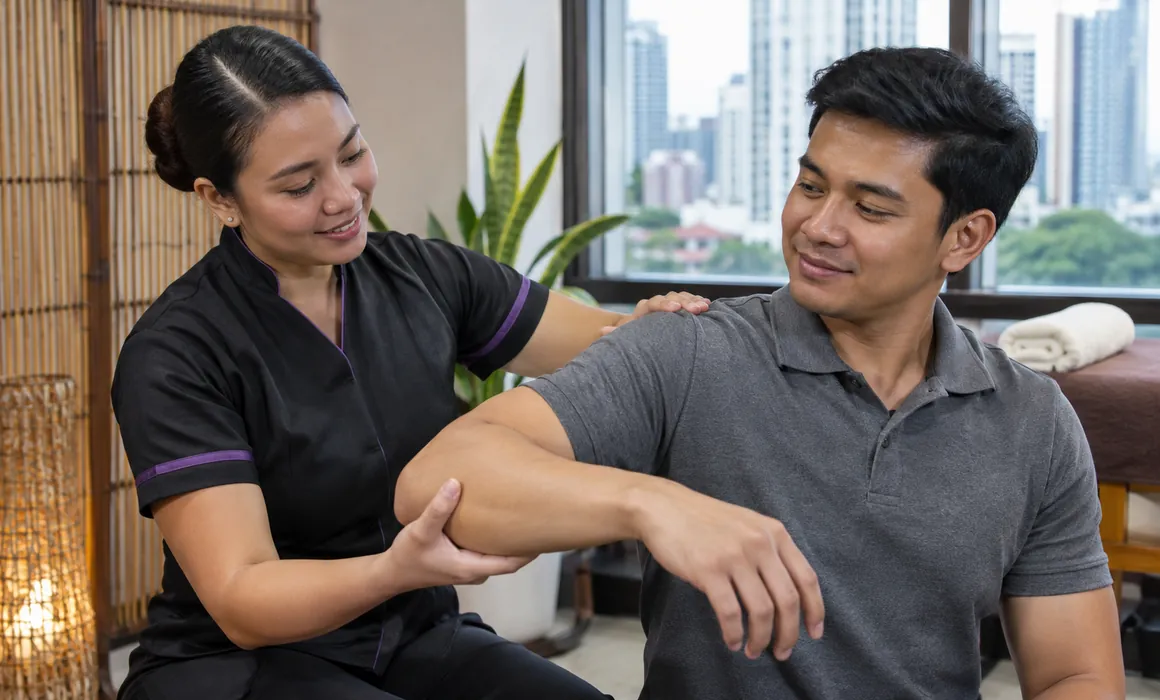
In an assisted stretch, another person helps move or support part of your body. During a massage, that might mean a therapist offers to guide an arm through a small movement while you rest on the table. Before the arm moves, agree on three things: what the therapist plans to move, what you will do, and what tells them to stop. You can book a hands-on visit and decline stretching altogether.
The word “assisted” can describe several different experiences. You may be asked to move your own arm while the therapist supports its weight. In a passive movement, the therapist guides it while you allow it to rest. If you haven’t agreed on which one is happening, each person may be waiting for the other to lead.
Start with an ordinary movement you recognize
Ask for a description you could act out while seated. “Your elbow stays bent and your arm moves a little away from your side” is easier to picture than the name of a joint movement. You can show how you normally use the arm without inviting the therapist to push it farther. The starting position may be the important part, especially when lying on a narrow table makes you feel you have less control.
If a practitioner asks you to contract or push against their hand, that is another instruction to clarify. Which way should you move? Can you stop doing the action yourself? An explanation and permission belong before a change in technique. The Thai massage preparation guide gives context for a style that can include assisted movement.
Support, stretching, and joint manipulation are different offers
Lifting an arm just enough to slip a cushion underneath need not involve stretching it. Guiding that arm toward a position intended to lengthen a muscle is a proposed stretch. An attempt to produce a joint sound or a rapid change in the joint is another activity altogether. Listen to the verb your practitioner uses and ask what will happen in observable terms. A sound or dramatic-looking photograph is a poor substitute for a purpose you actually share.
A useful question is whether the same goal can be met with the limb still. If you booked because your forearm feels tired and you want to rest, supported stationary work may meet that goal completely. If you are trying to restore a lost range after an injury, bring that goal to the professional supervising your rehabilitation. The decision about who moves the limb is much easier once the purpose of the appointment is honest.
Give the whole limb a resting place
Ask yourself which part of the effort belongs to you while the therapist is working. Are you holding the wrist up, keeping a knee from rolling out, or hovering an elbow beyond the edge of the table? Supporting that part can change the experience before anyone changes the pressure. A folded towel or a suitably placed pillow may solve a small gap, as long as it does not introduce pressure somewhere else.
Look at both ends of the limb. Supporting a wrist while the elbow hangs awkwardly can leave you holding the shoulder tense. Supporting the elbow while the fingers dangle may also feel wrong. Ask the practitioner to let you set a comfortable resting shape before either of you decides whether movement would add anything.
Try relaxing your fingers or toes in the chosen position without forcing a joint straight. If you feel you must keep a muscle switched on to stay where the practitioner put you, say so. The practitioner may be able to support the weight differently, use a different angle of approach, or offer a seated arrangement. Ask them to let you find a position you can leave easily.
Choose the endpoint before reaching it
A bigger movement is easy to see in a photograph. It says little about whether the movement suited you. Ask the therapist to stop while the position still feels easy, then decide whether to return to rest. Avoid bouncing or testing painful ranges. Mayo Clinic’s stretching guide describes a gentle approach and distinguishes stretching from pain. A wellness visit is a poor setting for testing the limits of an injured joint.
Choose who controls each phase of movement
| Situation | What to do | Why it matters |
|---|---|---|
| Starting position | Settle the limb on a support and identify the movement you are being offered. | It is much easier to decline a movement before your arm or leg is already in the air. |
| During movement | Decide whether you will move actively or let the practitioner guide a small movement. | If both people expect the other to lead, a comfortable motion can suddenly feel unpredictable. |
| At the first limit | Stop at your agreed boundary or earlier when anything feels uncomfortable. | Your practical limit is a decision about this movement today, not a flexibility target. |
| Returning to rest | Agree on who supports the limb until it reaches the pillow or table. | Knowing when support ends prevents an unexpected drop or a rushed effort to hold the limb up. |
Agree where movement will end
Try explaining how you normally get into and out of the position without assistance. A person who is accustomed to rolling to one side before sitting may want to keep that familiar sequence. If a clinician has given you movement restrictions, communicate the actual restrictions. Someone helping with a wellness appointment should never improvise a new way around them because the planned room is cramped.
One simple distinction makes a big difference: supporting an elbow while you turn your own forearm is different from taking your elbow and guiding the turn for you. Ask which action the therapist is proposing. If you cannot easily stop it yourself, a clear response from the person supporting your limb matters all the more.
Once settled, decide whether movement serves the purpose of this visit. You may want to spend the time resting rather than testing flexibility. Leaving out a movement is often an ordinary way of matching a session to the person receiving it.
Let a supported limb return slowly
One of the more awkward moments comes when a therapist thinks you have taken the weight of your arm and you think they are still supporting it. Agree on a handover. “I’ll bring your forearm back to the pillow, then let go” is a clear sequence. If you prefer to move your own limb, say so before the guide changes hands or moves a pillow.
Letting go of an arm without losing control of it
Picture a client who hears “let your arm relax” and tries to be helpful by moving it farther. The therapist interprets that effort as permission to continue. The client actually wants the limb supported because her forearm tires when held in the air. Naming those two intentions resolves the misunderstanding. The practitioner can support the weight without increasing the range, and the client can decide whether any movement at all is welcome.
- Will I move my arm, or will you support it while it rests? We should pick one arrangement before beginning. If the work changes, I can return your arm to its support and explain the next part.
- Can my hand come back to the pillow before we discuss a second movement? Yes. We can put it down comfortably and make the next decision while its weight is fully supported.
- What would make us leave the movement out altogether? If it conflicts with your clinical instructions, hurts, or is difficult to stop promptly, we can remove it from the plan.
Exercise lessons, fitness classes, and wellness appointments can use the same word for different movements. If you bring a stretch prescribed by a physical therapist, provide the original instruction to the person who prescribed it when you need a correction. A massage practitioner should not silently increase the range to make an existing exercise feel more challenging.
Make an ordinary dry run before anyone introduces a product
A short dry run can reveal problems that a verbal description misses. Choose the position, place the supports, set down belongings, and see whether communication still works. Nobody needs to apply oil, expose an area, or start massage during this check. You are deciding whether the arrangement fits the person in front of the practitioner.
A dry run for movement can stop before the stretch begins. Put the pillow and arm in the intended starting position, agree who will move, and then practice returning the limb to rest. If that return already feels awkward, there is little value in taking the stretch farther before fixing the handover.
During the trial, notice whether a sleeve pulls, a cushion blocks a route, or a signal is no longer visible. Ask for the adjustment you want and check it again in the same position. If it takes several changes just to remain comfortable, consider whether a simpler seated or clothed session would make more sense, provided it fits your needs.
Know when to bring a different question to a clinician
A loss of movement after a fall, recent surgery, repeated joint dislocations, or new weakness calls for individualized advice. A practitioner cannot tell which restrictions have been lifted by looking at how well you move on one particular afternoon. The comparison of massage and physical therapy can help you identify the right appointment. If you simply prefer a still session, ask about that option when reviewing Wellnessville’s services.
Ask for an instruction you can use outside the clinic
When a medical condition changes the decision, bring your healthcare professional a short description of the activity you are considering. Say whether you would be seated or lying down, which area would receive contact, and whether the service could involve pressure, heat, or movement. A clinician who understands the proposed activity can give more practical advice than one asked only whether a spa is okay.
When asking a clinician about a stretch, explain whether it is self-directed, assisted, or fully guided by someone else. A permission to move your arm actively after a procedure may not answer a question about force applied by another person. If the instructions use unfamiliar words, ask for a plain-language example of a permitted movement.
Clarify the extent of a restriction. Does it concern one region, a position you should avoid, or the timing of the entire visit? If the advice applies while a particular symptom persists or until a scheduled review, ask who should decide when that condition has changed. A previous okay does not settle a question that arose after a new procedure, symptom, or prescription.
Wording for a visit without unanticipated stretching
I’d like to know before any assisted movement is offered. Please keep my arms supported at rest unless we first agree on who will move them, how far, and how they’ll return to the table. I may choose to skip stretching entirely.
If your clinician has set a movement restriction, add it accurately and choose the right channel for private healthcare information. A professional who cannot confidently accommodate that restriction should say so. A good booking response gives you a clear decision about whether to reserve, without asking you to test the movement when the practitioner arrives.
Frequently Asked Questions
Does assisted stretching always involve a strap or resistance band?
No. Ask what equipment is proposed, who will handle it, and whether the movement can be left out if you dislike using it.
Do stretchy clothes have to be tight?
No. Choose clothing that permits comfortable movement and stays secure in the position being discussed.
Can a partner attend to learn a prescribed exercise?
Arrange exercise teaching with the clinician who prescribed it. A massage appointment may have a different purpose and visitor policy.
Can the two sides of my body have different movement limits?
Yes. You can set a separate limit for each side. A restriction from your clinician takes priority.
Do I need to measure my flexibility before booking?
No. A relaxation appointment does not require a home flexibility test. A rehabilitation clinician can decide whether a formal measurement is useful.
Try Our Massage Packages
Some of Our Massage Therapists